
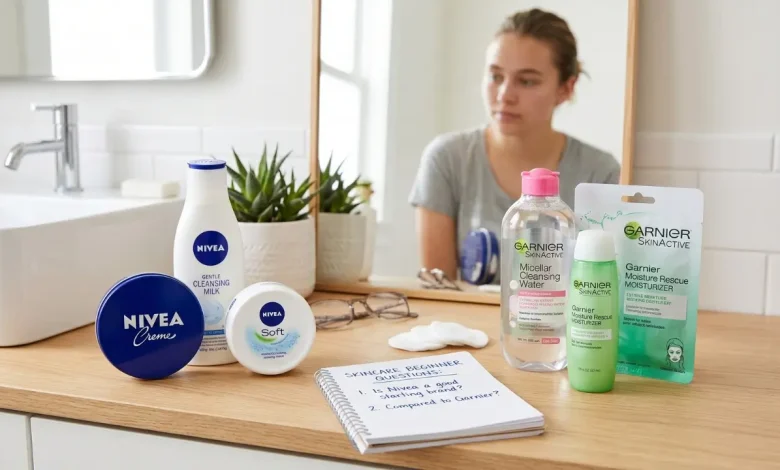
Starting skincare can feel surprisingly complicated. Walk into a store or browse online and you are immediately faced with cleansers, moisturizers, serums, micellar waters, sunscreens and products promising brighter, smoother or clearer skin. For a beginner, choosing between familiar brands such as Nivea and Garnier can therefore be a sensible first question.
The important point is that neither brand is automatically “better” for everyone. Your skin type, the product you choose and the ingredients in that particular formula matter more than the logo on the bottle. For someone starting from scratch, a simple routine built around gentle cleansing, moisturizing and daily sun protection is generally a better approach than buying several treatments at once.
Is Nivea a good starting skincare brand?
Yes, Nivea can be a reasonable starting point, particularly if your main goal is to keep your routine simple and concentrate on basic cleansing and moisturization.
Nivea has a broad skincare range, including products designed for different parts of the body and face. However, beginners should avoid assuming that every Nivea product is suitable for the face or for every skin type. A rich cream that feels comfortable on dry skin, for example, may not be the best choice for someone whose face is oily or prone to clogged pores.
The same principle applies to Garnier. The brand offers several different skincare categories, so choosing a product according to your skin’s needs is more useful than choosing a brand simply because it is popular.
Dermatologists at the American Academy of Dermatology recommend keeping a basic routine uncomplicated. Their guidance emphasizes gentle cleansing, moisturizing and sun protection rather than building a complicated collection of products.
Nivea vs Garnier: what is the real difference?
The biggest difference for a beginner is often the type of products you are interested in rather than an overall difference in quality.
Nivea is particularly well known for moisturizing and everyday skincare. Someone with normal or dry skin who primarily wants a straightforward moisturizer may find its range appealing.
Garnier, meanwhile, has a strong presence in cleansing and targeted skincare. Its Micellar range, for example, includes products aimed at removing makeup and impurities, with different formulas for different preferences and skin needs. Garnier also markets vitamin C skincare and daily UV products.
That does not mean Garnier is automatically better for oily skin or Nivea is automatically better for dry skin. Individual formulas can vary considerably within both brands.
A simple comparison
| What you want | Brand that may be worth exploring |
|---|---|
| Basic moisturizer | Nivea |
| Simple everyday skincare | Both |
| Makeup removal | Garnier |
| Micellar cleansing | Garnier |
| A richer moisturizing product | Nivea may have suitable options |
| Brightening-focused products | Garnier has several options |
| Beginner routine | Either, depending on the formula |
This is a general comparison, not a claim that every product from one brand will outperform the other.
What should a skincare beginner actually buy?
If you are completely new to skincare, resist the temptation to buy five or six products immediately.
A much more sensible starting routine is:
- Gentle cleanser
- Moisturizer suited to your skin type
- Broad-spectrum sunscreen with SPF 30 or higher
The American Academy of Dermatology recommends gentle, non-abrasive cleansing and advises against aggressive scrubbing. It also recommends moisturizing when appropriate and using broad-spectrum SPF 30 or higher for sun protection.
You do not necessarily need a separate serum, exfoliating acid, toner, face mask and multiple treatments when you are just starting.
In fact, introducing too many products at once can make it difficult to figure out which product is helping or irritating your skin.
Which brand is better for dry skin?
If your skin frequently feels tight, rough or flaky, your first priority should be hydration rather than chasing complicated “glow” routines.
A moisturizer can help reduce dryness by supporting the skin’s moisture barrier. The AAD recommends applying moisturizer when skin is still slightly damp because this can help trap water in the skin.
Nivea may appeal to beginners looking for moisturizing-focused products, but the specific formula still matters. Look at the product label and consider whether its texture and ingredients suit your face.
Garnier also offers hydrating products, so there is no reason to rule the brand out simply because you have dry skin.
What about oily or acne-prone skin?
This is where beginners need to be more selective.
Having oily skin does not mean you should stop moisturizing. The AAD specifically recommends moisturizing even for oily skin, while suggesting products described as oil-free or non-comedogenic when appropriate.
Instead of asking, “Is Nivea better than Garnier?” ask:
- Is the product designed for my skin type?
- Is it non-comedogenic if I am prone to clogged pores?
- Does it leave my skin excessively greasy?
- Does it cause burning, itching or persistent redness?
- Does the product have a clear purpose in my routine?
These questions are much more useful than choosing a brand based solely on reputation.
Is Garnier better if I want brighter-looking skin?
Garnier has a particularly visible range of vitamin C and brightening products. Its official UK information describes its Vitamin C Micellar Cleansing Water as a cleanser intended to remove makeup and impurities while providing a brightening-focused benefit.
The brand also sells vitamin C daily UV products and other brightening-focused skincare.
However, a beginner should not assume that adding more brightening products automatically produces better results.
If you are starting from zero, establishing cleansing, moisturizing and sun protection habits is more important than immediately adding several active ingredients.
Does Nivea or Garnier have to be your complete routine?
Not at all.
One of the biggest beginner mistakes is believing that a skincare routine has to come entirely from one brand.
You could use a Nivea moisturizer and a Garnier cleanser, for example, provided the individual products work well with your skin. You could also use neither brand if another product better matches your needs.
Skincare is about the formula and how your skin responds to it, not about brand loyalty.
The AAD also emphasizes that products do not need to be expensive to be effective and recommends keeping a routine simple.
How to choose your first Nivea or Garnier product
Before buying anything, identify your main skin concern.
If your skin is dry
Look for a moisturizer designed to provide comfortable, lasting hydration. Avoid aggressively cleansing or scrubbing your face.
If your skin is oily
Choose lightweight products and consider non-comedogenic or oil-free options where appropriate. A gentle cleanser is preferable to a harsh product designed to leave your skin feeling extremely stripped.
If your skin is sensitive
Keep the routine especially simple. Fragrance-free products can be a useful consideration because added fragrance can trigger irritation or allergic reactions in some people.
If you wear makeup
Garnier’s Micellar products may be worth considering because the brand offers several micellar formulas specifically intended for makeup removal and cleansing.
How to introduce a new skincare product
Do not change your entire routine overnight.
Introduce one new product at a time so you can identify what your skin tolerates. If you have sensitive skin, testing a small amount before applying a new product more broadly can be sensible. The AAD specifically recommends this approach for people with sensitive skin.
If a product causes significant burning, swelling, persistent redness or another concerning reaction, stop using it. For ongoing or severe skin problems, a dermatologist is a better source of personalized advice than a general product comparison.
Are Nivea and Garnier affordable for beginners?
Both are widely recognized mass-market skincare brands, but exact prices vary by country, retailer, product size and promotions. Because of those differences, there is no single reliable price comparison that applies everywhere.
Rather than choosing the cheapest bottle, compare the cost and size of the products you actually need.
A simple three-product routine can also be more economical than buying numerous trendy products. The AAD notes that limiting the number of skincare products can reduce costs while also reducing the possibility of irritation from using too many products.
Nivea or Garnier: which should a beginner choose?
There is no universal winner.
If your priority is basic moisturizing and uncomplicated everyday care, Nivea may be a comfortable place to begin.
If you are more interested in cleansing, micellar water or brightening-focused products, Garnier offers a particularly broad selection in those areas.
But the better choice ultimately depends on your skin. A well-suited product from either brand is more useful than a supposedly “better” product that does not agree with your skin.
For a complete beginner, I would prioritize a gentle cleanser, an appropriate moisturizer and a broad-spectrum SPF 30+ sunscreen before worrying about advanced treatments.
What trustworthy skincare guidance says
The most dependable part of this comparison comes from dermatology guidance rather than advertising claims.
The American Academy of Dermatology recommends simple skincare fundamentals: gentle cleansing, moisturizing and sun protection. It also emphasizes choosing products appropriate for your skin type and avoiding unnecessary irritation.
Brand-specific claims, meanwhile, should be treated as product information rather than proof that one brand is universally superior. For example, Garnier’s official product pages describe the ingredients and intended benefits of its own formulations, but those claims do not establish that Garnier as a whole is better than Nivea.
There is also no reliable basis for saying that either brand will work equally well for every person. Skin varies, and individual formulas matter.
Conclusion
If you are asking, “i’m a skincare beginner. is nivea a good starting brand compared to garnier?”, the short answer is yes, Nivea can be a good starting brand—but Garnier can be equally reasonable depending on the product and your skin type.
Don’t choose simply by brand name. Start with the basics, introduce products gradually and pay attention to how your skin responds. If you have dry skin and want straightforward moisturization, Nivea may be worth exploring. If cleansing or brightening is your main interest, Garnier has several relevant options.
Most importantly, you do not need a complicated routine to start taking good care of your skin.
FAQs
Is Nivea good for someone starting skincare?
Yes. Nivea offers many basic skincare products, including moisturizers, that can fit into a beginner routine. Choose the individual product according to your skin type rather than assuming every Nivea product will suit your face.
Is Garnier better than Nivea for beginners?
Not necessarily. Garnier may be especially appealing for beginners interested in micellar cleansing or brightening-focused skincare, while Nivea can be appealing for straightforward moisturizing. The best option depends on the product and your skin.
Can I use Nivea and Garnier products together?
Yes. There is generally no need to use products from only one brand. A cleanser from one brand and moisturizer from another can work perfectly well if both products suit your skin.
Should a beginner use vitamin C or other active ingredients?
Not necessarily. Beginners can first establish a basic routine of gentle cleansing, moisturizing and sun protection. Additional active ingredients can be considered later based on a specific skin concern and tolerance.
What is the most important skincare product for a beginner?
There is no single product that replaces a complete basic routine. Gentle cleansing, appropriate moisturizing and daily broad-spectrum SPF 30+ sun protection are strong foundations recommended by dermatology guidance.